Dakhil kharij (mutation): how land records change hands
Last reviewed:
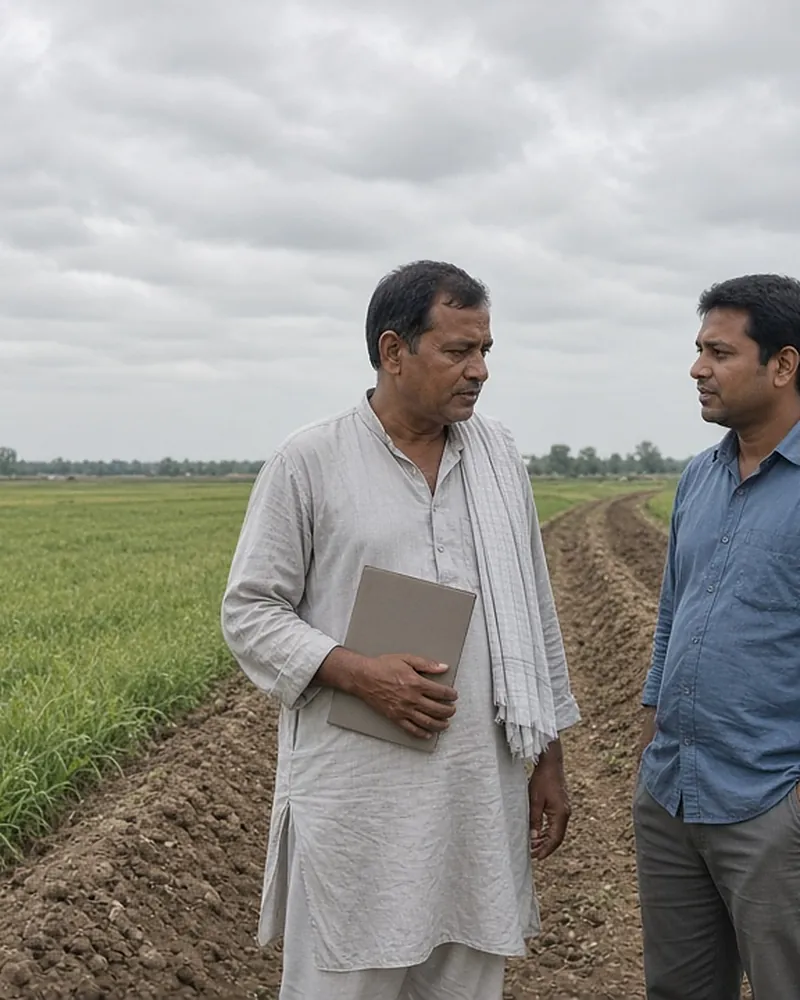
Dakhil-kharij (दाखिल-खारिज) means “entry and removal”: the new holder’s name is entered in the record of rights and the old holder’s name is removed for the land that changed hands. The same process is called namantaran (नामांतरण) in Uttar Pradesh and Madhya Pradesh, intkal in Punjab and Haryana, and mutation in English. It is needed after a sale, gift, exchange, partition, inheritance, will or court decree.
Mutation does not create or transfer title. The title passes by the registered deed, by inheritance or by the court’s decree. Mutation brings the revenue record into line with that change, so that land revenue is collected from the right person and the record shows the right holder to banks, buyers and government schemes. Skipping it causes real problems: the old name stays on the khatauni or jamabandi, a later buyer cannot be sure who holds the land, and in UP a person who has not reported the transfer cannot bring certain revenue suits.
Why registration alone is not enough
Registering a sale deed at the sub-registrar’s office makes the transfer legally effective, but the record of rights is kept by a different office: the Tahsildar or circle officer. In many states the registration office now sends the details across automatically. The PIB year-end review of 1 January 2026 reported that 88.6% of sub-registrar offices had been integrated with revenue offices. Even where that link exists, the mutation still goes through notice and inquiry before the record changes, and you should check that it has been completed.
Uttar Pradesh: namantaran under the Revenue Code
The Uttar Pradesh Revenue Code, 2006 sets the rules in sections 33 to 37.
- Report the transfer. Under section 34, every person who gets possession of land by transfer, including a family settlement, must report it to the Tahsildar of the tehsil where the land lies. The application can be made online under section 34 through the revenue court system at vaad.up.gov.in or at the tehsil. The state may fix a fee for the entry, payable by the person in whose favour it is made.
- Intimation from registration. Under section 36, when a document creating, assigning or extinguishing a title or charge on land is registered, the registering authority sends an intimation to the Tahsildar.
- Proclamation and inquiry. Under section 35, the Tahsildar issues a proclamation and makes the inquiry needed. If the case is not disputed, the khatauni is amended. If it is disputed, the Tahsildar decides the dispute and directs the amendment if necessary.
- Land revenue must be paid. Section 36(2) bars recording a mutation until the land revenue due on the land has been deposited.
- Appeal. Anyone aggrieved by the Tahsildar’s order can appeal to the Sub-Divisional Officer within 30 days of the order.
Section 37 adds that no suit or proceeding lies in a revenue court at the instance of a person who got land by succession or transfer until that person has made the report under section 33 or 34.
Tracking a UP mutation. Revenue court cases, including mutation cases, can be searched on vaad.up.gov.in, which also offers a plot-wise search. UP Bhulekh links each plot’s unique gata code to its mutation register and to its litigation and sale status.
Inheritance (varasat) in UP
Succession follows a different route. Under section 33, a person who gets land by succession reports it to the Revenue Inspector of the circle. If the case is not disputed, the Revenue Inspector records the succession in the khatauni; otherwise the Revenue Inspector inquires and reports to the Tahsildar. A person whose name was not recorded, or who disagrees with the Revenue Inspector’s action, can apply to the Tahsildar.
UP takes varasat applications online through the RCCMS varasat service, and the status of an application can be followed on the varasat status page. Keep the death certificate and the family details ready; the Revenue Inspector or lekhpal verifies them.
Bihar: online dakhil-kharij
Bihar’s process is set by the Bihar Land Mutation Act, 2011 and the Bihar Land Mutation Rules, 2012. The Bihar Bhumi dakhil-kharij FAQ sets out the key points:
- Online only and free. Applications are taken only on Bihar Bhumi, and mutation is free of charge.
- Within 90 days. Apply within 90 days of acquiring the land. After that, attach a delay-condonation petition, which the circle officer decides.
- Your own login. Register with your mobile number and apply from your own login so that you see every later step.
- Seller’s jamabandi must be online. The seller’s (or previous raiyat’s) jamabandi for the khesra must be online and must show enough area to be removed.
- OTP and token. The buyer’s mobile number is verified by OTP before final submission, and a token number is issued; its status is under “Mutation Defect Check Status”.
- No combined-area mutation. Land recorded as a combined area of two or more khesras (miljumla) cannot be mutated.
| How the land was acquired | Document |
|---|---|
| Sale, gift or exchange | Registered deed |
| Partition | Court partition order, registered partition deed, or a mutual or panchayati partition paper signed by all sharers |
| Inheritance without a will | Death certificate and family tree (vanshavali) |
| Will | Will with probate order |
| Court decree | Copy of the court order on title |
| Government settlement or Bhoodan land | Copy of the parcha |
What happens after you apply. The circle officer scrutinises the application and returns it to your login if anything is missing. The revenue karmachari then reports on each khesra after a physical check, and the revenue officer adds a report. The circle officer issues public and special notices and waits 14 days for objections. If objections come in, all sides are heard; if not, the circle officer passes the order. On approval a correction slip (shuddhi patra) is issued, and the area automatically moves from the old raiyat’s jamabandi to the new one. Status can be checked under “दाखिल-खारिज आवेदन स्थिति देखें” by district, circle, case number and financial year.
Objections, SMS alerts and appeals in Bihar
A jamabandi cannot be locked against mutation, but a raiyat can sign up for Bihar Bhumi’s SMS alert service on a khesra and will then be told at least 15 days before any mutation affecting it is carried out. Anyone can file an objection to a pending case online after logging in. Hearing dates are sent by SMS as well as served physically.
An appeal against a mutation order lies to the Deputy Collector Land Reforms (DCLR) within 30 days; after that, a delay-condonation petition must be attached. A revision against the DCLR’s order lies before the Collector or Additional Collector. A certified copy of the case record can be obtained from Bihar Bhu-Abhilekh.
Other states' online mutation services
| State | Portal | Service |
|---|---|---|
| Rajasthan | Apna Khata | Apply for mutation; mutation report |
| Punjab | Punjab Land Records | Mutation of inheritance; mutation on the basis of a deed |
| Andhra Pradesh | Meebhoomi | Mutation for transactions and for corrections |
| Karnataka | Bhoomi | Bhoomi online mutation, mutation history |
| Goa | DSLR Goa | Mutation status and mutation notices |
| Sikkim | ILRMS Sikkim | Inheritance and mutation applications |
| Andaman and Nicobar | Dweep Bhoomi | Mutation |
In the remaining states, mutation applications go to the tehsil or circle office, or through the services menu of the state land-record portal. Wherever you apply, keep the acknowledgement or case number: it is the only way to follow the case and to prove that you reported the transfer in time.
After the mutation
Open a fresh copy of the khatauni or jamabandi and check that the new name, share and area are correct and that the order behind the change is recorded. In UP the khatauni extract records the court or office, case number and date behind each entry; in Bihar the jamabandi shows the mutation case that created it. If something is wrong, it is corrected through record correction, not through a new mutation. Before buying, confirm that the seller’s own purchase was mutated; an unmutated earlier sale is one of the commonest problems found in land record verification.
FAQ
How long does mutation take?
It depends on the state and on objections. Bihar’s process includes a 14-day notice period before the order. UP’s Revenue Code requires a proclamation and inquiry but does not fix a period in the sections quoted.
Is there a fee for mutation?
Bihar’s mutation is free. UP’s Revenue Code allows the state to fix a fee for recording a transfer; the amount is shown when you apply.
Can I apply for mutation without registering the sale?
No. For a sale, gift or exchange, Bihar requires the registered deed, and in UP the registering authority’s intimation and your report rest on the registered document.
What if someone else’s mutation affects my land?
File an objection before the order: online on Bihar Bhumi, or before the Tahsildar in UP after the proclamation. After the order, appeal within 30 days.